
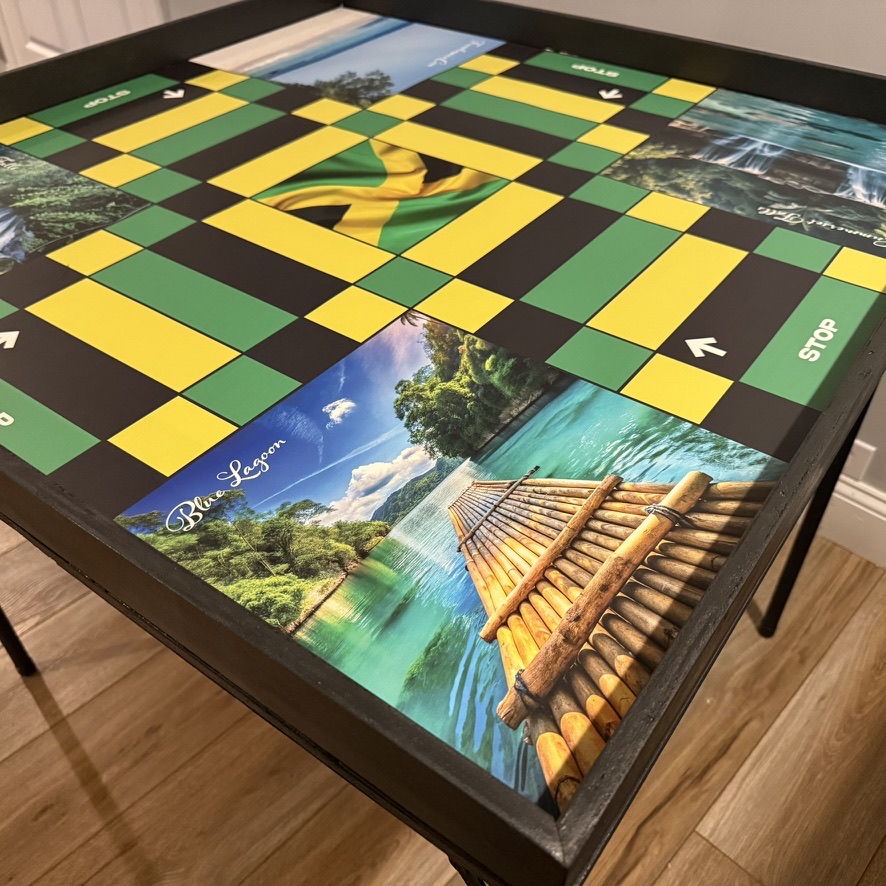
Ludi is the Jamaican name for the board game most of the world knows as ludo — and if you grew up in a Jamaican household, you probably know it as something louder than a board game. It’s the game that comes out at family gatherings, on verandas and in yards, with the dice slammed down hard enough to rattle the pieces and everyone at the table convinced they know the “real” rules.
This guide covers the rules most families agree on, the house rules they argue about, and a few tips for winning. If you’re new to the game, you’ll be ready to play in ten minutes.
What you need
- A ludi board. A cross-shaped board with a home corner for each player. Traditional Jamaican boards are often handmade with a raised wooden frame, so the die and pieces stay on the board.
- Four pieces per player, each player with their own color. Poker chips make great ludi pieces — they’re bold, easy to count and easy to stack.
- One die. Many players also use a small cup to shake and slam the die, which is half the fun.
- Two to four players.
How the ludi board works
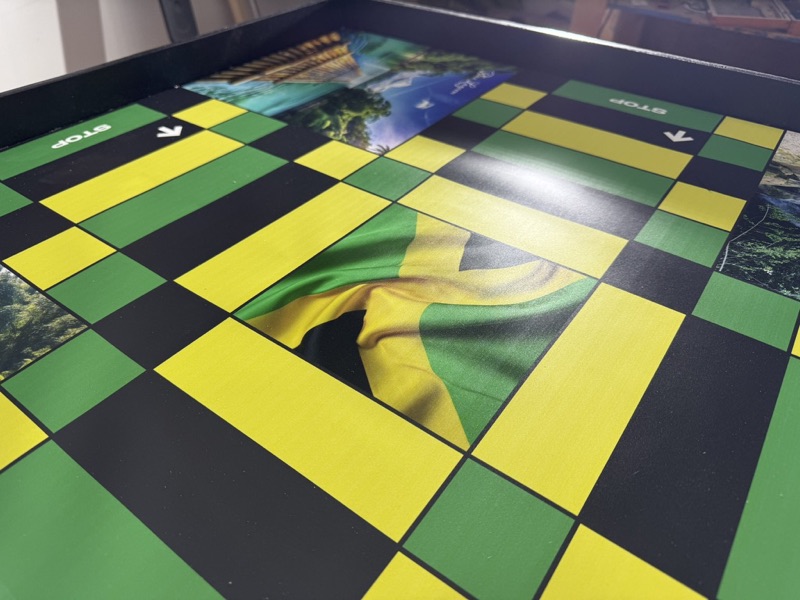
A ludi board is shaped like a plus sign, with a square home corner between each pair of arms. Every part of it has a job:
- Home corners — one per player. All four of your pieces start here.
- The track — the outer lanes of spaces running around all four arms. This is the loop every piece has to travel.
- Start squares — the space where your pieces enter the track. It’s on the arm next to your home corner, and many boards mark it clearly.
- Your home lane — the middle lane of the arm in front of you, leading in to the center. Only your own pieces can enter it.
- The center — the finish. A piece that reaches it is safely home.
Most boards add arrows to show where pieces turn into their home lane, and some — including many Jamaican boards — label certain spaces. Families use those markings in slightly different ways, so it’s worth a quick “what does this space mean here?” before you start.
How to set up a game
- Choose your colors. Each player picks a color and the home corner in front of them, and puts their four pieces in it.
- Decide who goes first. Everyone rolls once; the highest roll starts. Re-roll any ties.
- Agree on direction. Most families play clockwise — turns pass to the left, and pieces travel around the board in the same direction.
- Agree on house rules before the first roll. (See below — this step prevents most of the shouting.)
How to play ludi: the core rules
These are the rules almost every Jamaican family plays with.
1. Roll a six to get out
A piece can only leave your home corner when you roll a six. When you do, move one piece onto your start square. If you have no pieces on the board and don’t roll a six, your turn is over.
2. Move one piece the number you roll
On each turn, roll the die and move one of your pieces forward that many spaces along the track. You can’t split a roll between two pieces. If none of your pieces can legally move, you pass.
3. Sixes roll again
Roll a six and you get another roll after you move. You can use a six either to bring a new piece out or to move a piece already on the board.
4. Capture by landing exactly on an opponent
Land exactly on a space occupied by an opponent’s piece and that piece is captured — it goes back to its owner’s home corner and needs another six to come out. Passing over a piece doesn’t capture it; only landing on it does.
5. Go all the way around, then up your home lane
Each piece travels one full lap of the track. When it comes back around to your arm, it turns into your home lane instead of starting another lap, and heads for the center. Opponents can’t follow you in there, so a piece in its home lane is safe.
6. Get home on an exact roll
In most games, a piece has to reach the center with an exact roll. If you’re three spaces away, you need a three — anything higher and that piece can’t move this turn.
7. First to get all four pieces home wins
The first player to bring all four pieces into the center wins. If you’re playing for places, keep going until second and third are decided.
House rules families argue about
Ludi rules change from yard to yard. None of these is “wrong” — just agree on them first.
- Blocks. If two of your pieces share a space, can opponents pass it? Many families say no: a doubled pair forms a block nobody can jump or land on.
- Three sixes in a row. A reward, or a penalty? In some games, a third straight six ends your turn and sends your last-moved piece home.
- Bouncing back. If your roll is too high to land exactly in the center, some players move in and back out with the extra count instead of losing the move.
- Coming out on a one. Some families let a one bring a piece out as well as a six, to keep games moving.
- Safe spaces. Some boards and families treat start squares or marked spaces as safe, where pieces can’t be captured.
- Must you capture? In some houses, if you can capture, you have to.
- The dice cup. Shake it, slam it, and the roll counts only if the die stays on the board. In some yards, a die that leaves the board is a lost turn.
Tips for winning at ludi
- Get pieces out early. A piece in your home corner can’t do anything. Use your early sixes to bring pieces onto the board.
- Don’t race one piece alone. A single runner far ahead is easy to chase. Moving a few pieces gives you more choices each roll.
- Keep a piece near your start. A piece waiting just behind an opponent’s path is a threat — anything that lands within six spaces ahead of it is in danger.
- Count before you move. Before choosing a piece, check which of your pieces is within one roll (six spaces) of an opponent — and which of theirs can reach yours.
- Use your home lane. Once a piece is in its home lane it can’t be captured, so getting a piece safely into it is often better than moving a piece out in the open.
- Use blocks if your house allows them. A doubled pair just in front of an opponent can stall their whole game.
Make the game yours
Half the fun of ludi is the board itself. In Jamaica and across the diaspora, boards are often handmade and decorated with the flag, the island’s colors and pictures that mean something to the family.
At Jamaican Ludi we handcraft custom ludi boards with your photos in the corners, your choice of center, and the color of every space — printed in rich color on vinyl, sealed under epoxy, and framed in wood. Every board comes with poker chips and dice, so you can start playing the day it arrives. See the boards we’ve made or check sizes and prices.
Frequently asked questions
How many people can play ludi?
Two, three or four players. With four, some families play in partners — the players sitting opposite each other team up, and both of their pieces have to get home to win.
How many pieces does each player get?
Four. Any small tokens work, as long as each player’s are a different color. Poker chips are popular because they’re easy to see, easy to stack and hard to knock over.
Do you play ludi with one die or two?
Most Jamaican families play with one die. Some yards play with two, using each die as a separate move. Agree before the first roll.
Do you need a six to start?
In the most common rules, yes — a piece can only leave home on a six. Some families also let a one bring a piece out to speed the game up.
What happens if you land on an opponent’s piece?
It’s captured and goes back to its owner’s home corner. To bring it out again, they need another six.
How long does a game of ludi take?
Usually 20 to 45 minutes with four players, depending on how many pieces get sent home — and how long the arguments about house rules last.